Do Probiotics Actually Reduce Acne?
In 2025, Sutema et al. published a scoping review in the Journal of Experimental Pharmacology covering 15 RCTs and 811 participants from 2009 to 2024 - the most comprehensive sweep of this evidence to date. The finding: both oral and topical probiotics reduced acne lesion counts, improved skin barrier function, and decreased inflammatory markers. Several studies reported outcomes comparable to conventional treatments including benzoyl peroxide.
That's an encouraging headline. But read further and a critical caveat emerges: individual responses vary significantly by strain, dose, and the starting state of the person's gut microbiome. A "probiotic" isn't a single thing any more than an "antibiotic" is - and the strains that show real signal in trials are not always the ones on the shelf at your local pharmacy.
The most specific trial data comes from a 2024 randomized, double-blind, placebo-controlled study published in Acta Dermato-Venereologica. Over 12 weeks, patients aged 12-30 with acne vulgaris took a capsule containing Lacticaseibacillus rhamnosus (CECT 30031) combined with the cyanobacterium Arthrospira platensis. Results: 50% of the probiotic group showed improvement on the Acne Global Severity Scale, compared to 29.4% in the placebo group (p = 0.03). Non-inflammatory lesion counts fell significantly more in the treatment arm.
How the Gut-Skin Axis Connects Your Microbiome to Your Breakouts
To understand why probiotics affect skin, you need the mechanism - and it runs through what dermatologists call the gut-skin axis. A disrupted gut microbiome (dysbiosis) compromises the intestinal barrier, allowing bacterial endotoxins like lipopolysaccharide (LPS) to enter the bloodstream. This triggers a systemic inflammatory response. Circulating inflammatory cytokines - including IL-1-beta, IL-6, and TNF-alpha - reach sebaceous glands, promoting excess sebum production and creating the inflammatory environment that drives papules and cysts.
A 2025 Oxford Academic study in Skin Health and Disease used Mendelian randomization to establish a causal (not just correlational) relationship between gut microbial composition and acne risk. That's a methodologically stronger claim than observational data alone: certain gut microbial profiles causally increase acne likelihood.
Probiotics interrupt this chain in two ways. First, they restore microbial diversity, reducing dysbiosis and strengthening the gut barrier. Second, specific strains directly modulate immune signaling - the December 2025 Medicina meta-analysis confirmed that selected probiotic strains reduce pro-inflammatory cytokines IL-1-beta, IL-6, and TNF-alpha, and enhance epithelial barrier integrity. These aren't abstract mechanisms - they map directly onto the steps that lead from gut imbalance to acne inflammation.
The Strains That Actually Show Up in the Evidence
Most probiotic marketing talks about Lactobacillus as a category. The clinical trials are more specific. Here's what the evidence actually supports:
| Strain | Evidence | Mechanism |
|---|---|---|
| Lacticaseibacillus rhamnosus (CECT 30031) | 2024 Acta Dermato-Venereologica RCT: 50% vs 29.4% improved (p = 0.03) | Reduces gut dysbiosis, modulates tryptophan metabolism, lowers systemic inflammation |
| Bifidobacterium species | Multiple RCTs in the 2025 Sutema scoping review; known immune tolerance mechanism (Gavzy et al., Gut Microbes, 2023) | Immune modulation, strengthens gut barrier, reduces inflammatory cytokine signaling |
| Bacillus coagulans | Included in 4 of the 15 studies in the Sutema review; generally well-tolerated | Survives gastric transit as spore; produces lactic acid to shift gut pH; reduces C. acnes-linked inflammation indirectly |
| Multi-strain oral synbiotics | 2025 Springer dermatology trial (8-week, 2023-2024): modified hormone levels and gut microbiome in non-cystic acne | Combined prebiotic + probiotic effect; hormonal and microbial modification simultaneously |
One important note from a 2026 Wiley meta-analysis in the Journal of Cosmetic Dermatology: when Lactobacillus-based probiotics were compared head-to-head with benzoyl peroxide, there was no statistically significant reduction in total lesion counts. Probiotics are additive and protective - especially during antibiotic courses that damage gut diversity - but they're not yet proven superior to standard topicals for lesion reduction alone.
Fermented Foods vs Supplements: What Gets the Dose Right?
The clinical trials that show results use specific strains at therapeutic doses - often in the range of several billion CFUs (colony-forming units) per day. Fermented foods deliver live cultures, but at doses and strain profiles that are unpredictable and generally lower than what trials test.
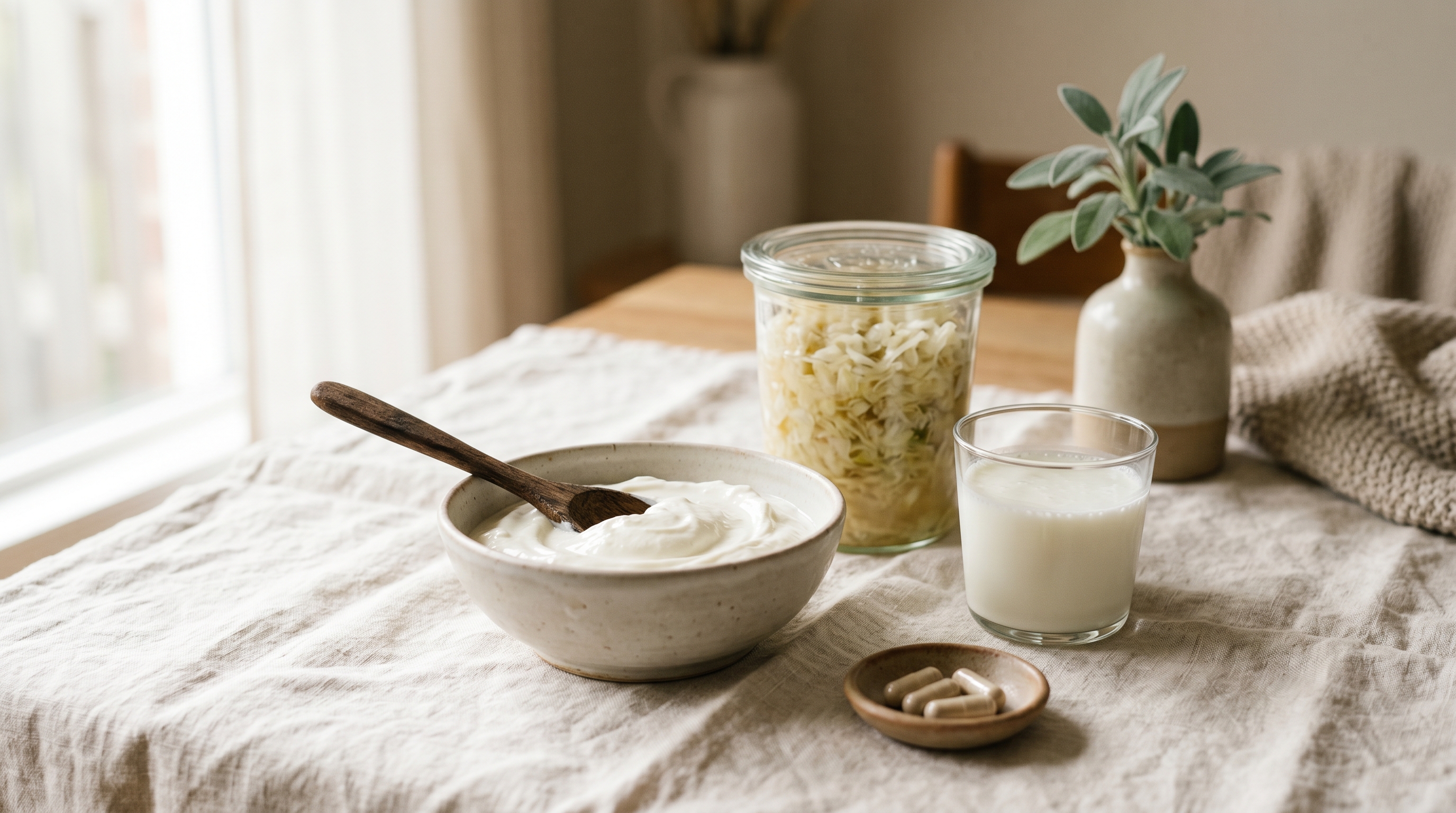
That doesn't make fermented foods useless. Yogurt, kefir, kimchi, miso, and sauerkraut all contribute to microbiome diversity in ways that matter for the gut-skin axis. But if you're hoping to replicate the effect of a 12-week probiotic RCT by eating a daily yogurt, you're probably undershooting on dose and almost certainly on strain specificity.
The practical approach: use food to build a foundation (diversity matters), use targeted supplements when you have a specific goal (active acne, post-antibiotic recovery) and pick supplements that specify strain names, not just genus. "Lactobacillus" on a label tells you nothing useful. "Lacticaseibacillus rhamnosus CECT 30031" tells you something.
Your diet patterns upstream of the gut microbiome matter just as much. High-glycemic eating - refined carbs, sugary drinks - drives insulin and IGF-1 spikes that increase sebum production independently of the microbiome. Pairing probiotics with a lower-glycemic diet addresses two acne drivers simultaneously rather than one.
Taking Probiotics Alongside Acne Antibiotics
This is where probiotics offer some of their clearest practical value. Oral antibiotics - doxycycline, minocycline, sarecycline - are still first-line for moderate acne. But they cause significant collateral damage to the gut microbiome. Research published in PMC in 2024 found that minocycline reduced beneficial Lactobacillus populations and key microbial families including Ruminococcaceae and Clostridiaceae, with incomplete recovery after the course ended. Sarecycline caused the least disruption of the three, but dysbiosis still occurred.
Taking a probiotic alongside an antibiotic course - ideally spaced 2-3 hours apart so the antibiotic doesn't kill the probiotic before it's absorbed - may help preserve microbiome diversity during treatment. This has knock-on benefits for the gut-skin axis and for avoiding the post-antibiotic rebound breakouts that some people experience as gut flora recovers.
If you're also dealing with dairy-triggered acne alongside your antibiotic course, it's worth reading the evidence on dairy and acne - the IGF-1 mechanism is distinct from the microbiome pathway but compounds it. For hormonal acne specifically, diet modifications targeting hormonal drivers stack well with both probiotics and microbiome support.
What to Realistically Expect - and How to Track It
The trials that show meaningful results run for 8-12 weeks. That's the minimum window to expect visible change from a microbiome intervention - gut flora shifts take weeks, and their downstream effects on skin inflammation take longer still. Starting a probiotic and judging results after two weeks is like planting a seed and digging it up to check progress.
Most people also underestimate how much their diet is either supporting or undermining the probiotic they're taking. A probiotic can help restore microbial balance, but it can't outrun a diet that's chronically high in refined carbohydrates, skim dairy, or processed food - all of which create the inflammatory and hormonal environment where Cutibacterium acnes thrives.
The most useful thing you can do alongside a probiotic trial is track what you're eating and how your skin responds - not loosely, but with enough specificity to spot patterns. Scan your meals, note your breakout patterns over 4-week intervals, and look for correlations. That's the kind of data that turns a vague "I think probiotics helped?" into an actual answer.
See what every meal does to your skin
Glowcast scores your food on 8 dermatology dimensions - including gut-skin axis impact - so you know which meals are helping your microbiome and which ones are working against it.
Download Glowcast - FreeFrequently Asked Questions
Do probiotics actually help with acne?
Yes, with meaningful caveats. A 2025 scoping review of 15 RCTs and 811 participants (Sutema et al., Journal of Experimental Pharmacology) found that oral and topical probiotics reduced acne lesions and inflammatory markers. A 2024 double-blind RCT showed 50% of a probiotic group improved on the Acne Global Severity Scale vs 29.4% on placebo (p = 0.03). Results vary significantly by strain, dose, and individual gut microbiome baseline.
Which probiotic strains work best for acne?
The best-evidenced strains for acne are Lacticaseibacillus rhamnosus (specifically CECT 30031), Bifidobacterium species, and Bacillus coagulans. Multi-strain synbiotic formulas also show promise. Look for products that name the specific strain - a label that just says "Lactobacillus" tells you very little about whether it matches anything tested in trials.
How long do probiotics take to improve acne?
Clinical trials testing probiotics for acne use 8-12 week treatment windows. The 2024 Acta Dermato-Venereologica RCT measured significant improvement after 12 weeks. Most visible skin changes from gut microbiome interventions take at least 6-8 weeks. Give it a full 12-week trial before drawing conclusions.
Can fermented foods replace probiotic supplements for acne?
Fermented foods (yogurt, kefir, kimchi, sauerkraut) support microbiome diversity and are worth including daily. But they typically deliver lower and less predictable CFU counts than the therapeutic doses used in acne RCTs, and strain specificity is zero. Use food as a foundation; use targeted supplements when you need precision.
Are probiotics safe to take alongside acne antibiotics?
Generally yes - and there's a good reason to do so. Research shows minocycline causes significant gut dysbiosis with incomplete bacterial recovery after treatment ends. Taking a probiotic 2-3 hours apart from your antibiotic dose may help preserve microbiome diversity during the course. Always confirm with your prescribing dermatologist.
Sources
- Sutema et al., "Efficacy of Probiotic Supplements and Topical Applications in the Treatment of Acne: A Scoping Review of Current Results," Journal of Experimental Pharmacology, January 2025. Retrieved 2025-06-10. https://pmc.ncbi.nlm.nih.gov/articles/PMC11727500/
- Eguren C et al., "A Randomized Clinical Trial to Evaluate the Efficacy of an Oral Probiotic in Acne Vulgaris," Acta Dermato-Venereologica, May 2024. Retrieved 2025-06-10. https://pmc.ncbi.nlm.nih.gov/articles/PMC11110809/
- "Oral Probiotics in Acne vulgaris: A Systematic Review and Meta-Analysis of Double-Blind Randomized Clinical Trials," Medicina, December 2025. Retrieved 2025-06-10. https://www.mdpi.com/1648-9144/61/12/2152
- Abedin et al., "Lactobacillus-Based Microbiome Therapy for Acne Vulgaris: A GRADE Systematic Review and Meta-Analysis of Randomized Controlled Trials," Journal of Cosmetic Dermatology, March 2026. Retrieved 2025-06-10. https://onlinelibrary.wiley.com/doi/full/10.1111/jocd.70792
- "Unravelling the causal link between gut microbiota and acne risk using a genetic approach," Skin Health and Disease, Oxford Academic, November 2025. Retrieved 2025-06-10. https://academic.oup.com/skinhd/article/5/6/448/8315044
- "Global, regional and national burdens of acne vulgaris in adolescents and young adults aged 10-24 years from 1990 to 2021," British Journal of Dermatology, September 2024. Retrieved 2025-06-10. https://academic.oup.com/bjd/article-abstract/192/2/228/7756775
- "The Role of the Skin Microbiome in Acne: Challenges and Future Therapeutic Opportunities," PMC, November 2024. Retrieved 2025-06-10. https://pmc.ncbi.nlm.nih.gov/articles/PMC11546345/