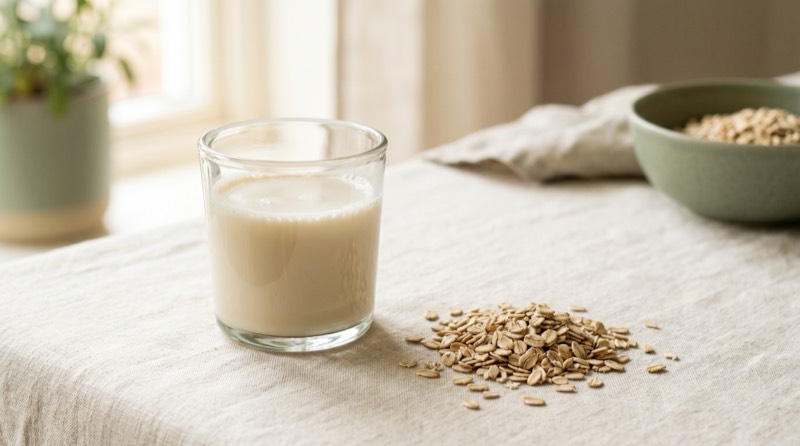
Nothing links oat milk to acne. Pick unsweetened. Oat drinks sit close to cow's milk on sugar, and in lab tests most plant drinks raise blood sugar a bit faster than milk. Cow's milk is still the drink with the clearer acne story. Oat is a swap, not a proven skin food.
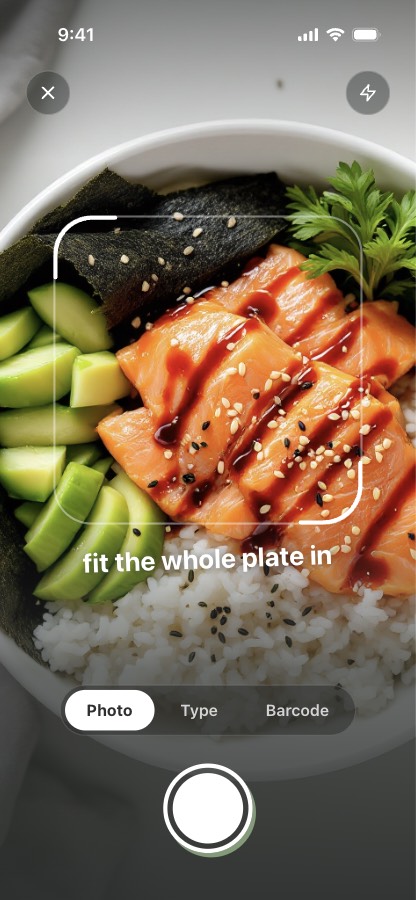
what about your plate?
Snap your plate in Glowcast
See how it rates for your skin. 7-day trial on iPhone.


- Nothing links oat milk to acne. Nobody has measured spots after people drank it.
- A slow-carb plate cut spots in diet trials. That is a whole-plate change, not a glass of oat milk.
- Oat milk has none of the cow-milk hormones people worry about. That still does not make it a skin treatment.
- Unsweetened, barista-style oat milks have the most processing and often the highest sugar content - read the label before assuming "oat" equals clean.
- If you swap milk, give it about 12 weeks and track your own skin. A couple of weeks is too soon.
What Makes Oat Milk Different From Other Plant Milks?
Oat milk starts as whole rolled oats blended with water, then enzyme-treated to break down the starch and strained to a drinkable consistency. That enzymatic processing converts oat starch into shorter-chain sugars - primarily maltose - that your gut absorbs rapidly. In 2023, researchers at Wageningen University reviewed glycemic responses across milk types and found that plant-based drinks like oat milk lack the food-matrix properties of dairy that slow gastric emptying and moderate blood glucose uptake (Shkembi & Huppertz, Foods, 2023).
The result: a cup of oat milk raises your blood sugar considerably faster than the equivalent volume of cow's milk. Whole dairy milk has a GI of roughly 31 because lactose is a slow-digesting disaccharide and the fat content further slows absorption. Oat milk lands around 69 on the same scale - a meaningful difference when you're thinking about skin.
Compare that to other common alternatives:
- Unsweetened almond milk: GI ~25-30 (very low - mostly water and fat)
- Unsweetened soy milk: GI ~30-34 (protein buffers the glycemic response)
- Whole dairy milk: GI ~31 (fat + lactose structure slows absorption)
- Oat milk (standard): GI ~69 (rapid starch digestion)
- Rice milk: GI ~85+ (highest of the common alternatives)
Oat milk isn't the worst offender - rice milk is. But it sits in a zone that dermatologists flag as potentially problematic for acne-prone skin.
Why blood sugar speed comes up at all
High-glycemic foods - including oat milk - raise insulin and insulin-like growth factor 1 (IGF-1), which then stimulate sebum production and androgen hormone release, directly contributing to acne development. This isn't a fringe theory: it's the established mechanism behind decades of research linking diet and breakouts. A 2024 clinical trial published in Cureus confirmed that women on low-glycemic-load diets saw acne severity scores drop from 2.68 to 1.56 over 12 weeks, compared to minimal improvement in the control group (Raza et al., Cureus, 2024).
The chain works like this:
- You drink oat milk. Maltose from the processed oat starch enters your bloodstream quickly.
- Blood glucose rises. Your pancreas secretes insulin to clear it.
- Insulin signals IGF-1 production. IGF-1 is a growth factor that tells cells - including sebaceous gland cells - to proliferate and produce more.
- Sebaceous glands go into overdrive. More sebum means more opportunity for pores to clog, bacteria to feed on, and inflammation to follow.
- Androgens amplify the signal. IGF-1 also boosts androgen activity, which further stimulates oil glands - particularly relevant for hormonal acne patterns.
The landmark 2007 RMIT University randomized controlled trial established that a low-glycemic-load diet reduced total acne lesion counts by 23.5 compared to 12.0 in the control group over 12 weeks - and improved insulin sensitivity alongside it (Smith et al., American Journal of Clinical Nutrition, 2007). The mechanism is consistent, even if individual responses vary.
Oat Milk vs Dairy: Which Is Actually Worse for Acne?
This is where the comparison gets genuinely nuanced - because the two milks trigger acne through different pathways, and which is "worse" depends on which pathway your skin is more sensitive to.
Dairy's acne mechanism
Cow's milk contains IGF-1 directly, plus androgen precursors such as 5-alpha-pregnanedione that enhance 5-alpha-reductase activity - the enzyme that converts testosterone into the potent androgen DHT, which drives sebaceous gland overactivity. A 2026 integrative review in the Journal of Integrative Dermatology confirmed that dairy intake, especially skim milk, is associated with increased acne prevalence and severity, while dairy proteins like whey and casein also independently stimulate insulin secretion (Keelin & Lio, Journal of Integrative Dermatology, 2026).
Oat milk's acne mechanism
Oat milk is entirely hormone-free - it contains no IGF-1, no androgens, no whey, no casein. Its acne risk comes entirely from its carbohydrate profile and the downstream glycemic response. For someone whose acne is primarily driven by hormones in dairy, switching to oat milk is a genuine improvement. For someone whose acne is primarily driven by glycemic spikes, the switch may not help as much as expected.
In practice, many dermatologists recommend switching from dairy if you have persistent acne - and oat milk is the most popular substitute people reach for. Whether it resolves the problem depends on which mechanism was doing the damage.
Who Is Most Likely to Break Out from Oat Milk?
Not everyone who drinks oat milk gets acne. The glycemic impact is real, but individual response varies considerably based on a few factors worth understanding.
You may be more susceptible if:
- Your acne is predominantly on the lower face and jaw. Hormonal acne that cycles with your period suggests androgen sensitivity - meaning glycemic spikes that raise IGF-1 are more likely to affect you.
- You're drinking sweetened or flavored oat milk. Many commercial brands add cane sugar or oat-based sweeteners on top of the naturally occurring maltose. A sweetened variety can push the effective glycemic load considerably higher than the baseline GI of 69 suggests.
- You're having large servings. A splash in coffee has a very different glycemic impact than two large glasses. Quantity matters as much as type.
- You have insulin resistance or PCOS. If your insulin sensitivity is already compromised, the same blood sugar spike produces a larger hormonal response - and a more pronounced effect on your skin.
- You switched from dairy and expected a complete clear-up. If your dairy-driven acne improved only partially, oat milk's glycemic load could be sustaining the remaining breakouts.
Practical Guidance: How to Use Oat Milk Without Wrecking Your Skin
You don't necessarily need to eliminate oat milk entirely. These specific adjustments make a meaningful difference for most people.
Choose the right product
Look for unsweetened oat milks with fewer than 5g of sugar per serving and a minimal ingredient list - ideally just oats, water, and a stabilizer like sunflower oil or acacia gum. Avoid "barista edition" versions unless you know the brand; these are often higher in engineered starch content for frothing performance. If the ingredient list includes "oat flour" rather than whole oats, expect a higher glycemic response.
Control your portion
A 30-50ml pour in espresso has a negligible glycemic impact. Two large glasses a day - especially with other high-GI foods - stacks up. Track your total daily intake alongside your skin response rather than treating it as a binary good/bad food.
Pair it with fat or protein
Consuming oat milk alongside fat or protein slows gastric emptying and blunts the blood sugar spike. A latte made with oat milk drunk with a handful of nuts or a protein-rich breakfast has a lower net glycemic impact than oat milk consumed on its own.
Run a 14-day elimination test
The only reliable way to know if oat milk is affecting your specific skin is to remove it for two full weeks - alongside other high-GI foods - and observe. Tracking your Glow Score in the Glowcast app each day gives you an objective read on how your skin is responding to dietary changes, rather than relying on memory and subjective impression. The app scores every meal across 8 dermatology dimensions including glycemic impact, so oat-milk-heavy days show up in your data immediately.
Consider lower-GI alternatives
If you're committed to going dairy-free but want to minimize glycemic risk, unsweetened almond milk and unsweetened soy milk are the two most dermatologist-recommended alternatives. Soy offers a protein profile similar to dairy milk (~7g per serving) without the hormones or the high GI. Pea milk is a newer option with a comparable protein level and low glycemic impact - worth trialing if soy doesn't suit you.
Know your glow before it shows.
See what oat milk does to your Glow Score
Scan any meal. Get an instant score across 8 skin-health dimensions - including glycemic impact - personalized to your skin type.
Try Glowcast for 7 daysSwapping milks is only part of the story. See the best foods for clear skin, the evidence on dairy and acne and on whey protein, and why glycemic load and added sugar matter for skin.
Frequently Asked Questions
Does oat milk cause acne?
Nothing links oat milk to acne. Pick unsweetened. Oat drinks sit close to cow's milk on sugar. Cow's milk is the drink with the clearer acne story. Give a milk swap about 12 weeks.
Is oat milk better or worse than dairy milk for acne?
Cow's milk has the clearer acne link. Oat milk is a swap, not a proven skin food. Pick unsweetened. If extra milk lines up with flares, swap it and give it about 12 weeks.
Which plant milk is best for acne-prone skin?
Unsweetened soy or almond drinks average less sugar than oat. Nothing has measured acne after people drank any plant milk. Pick unsweetened and keep the rest of your plate the same while you test.
What makes oat milk spike blood sugar compared to whole oats?
A bowl of oats digests slower than a glass of oat milk. The drink is oats blended with water, then strained, so it can raise blood sugar a bit faster. That still has not been tested as an acne trigger. Pick unsweetened either way.
Sources
- Raza Q, et al. "Effect of a Low-Glycemic-Load Diet and Dietary Counseling on Acne Vulgaris Severity Among Female Patients Aged 15 to 35 Years." Cureus, 2024 Nov 2;16(11):e72886. Retrieved 2026-05-28. pubmed.ncbi.nlm.nih.gov/39624570
- Smith RN, et al. "A low-glycemic-load diet improves symptoms in acne vulgaris patients: a randomized controlled trial." American Journal of Clinical Nutrition, 2007 Jul;86(1):107-15. Retrieved 2026-05-28. pubmed.ncbi.nlm.nih.gov/17616769
- Shkembi B, Huppertz T. "Glycemic Responses of Milk and Plant-Based Drinks: Food Matrix Effects." Foods, 2023 Jan 18;12(3):453. Retrieved 2026-05-28. pmc.ncbi.nlm.nih.gov/articles/PMC9914410
- Keelin J, Lio P. "Milk and Skin: A Narrative, Integrative Review of Dairy and Dairy Substitutes Through the Lens of Cutaneous Inflammation." Journal of Integrative Dermatology, 2026. Retrieved 2026-05-28. jintegrativederm.org/doi/10.64550/joid.kcfbqe72
- Telkkala L, et al. "Etiology of Adult Female Acne - Systematic Review." Health Science Reports, 2025 Apr;8(4):e70697. Retrieved 2026-05-28. onlinelibrary.wiley.com/doi/full/10.1002/hsr2.70697
Written by Glowcast. Food inspo, not medical advice. For skin that worries you, see a dermatologist. How we check the science